Seven new insect predation events by adults of Hemidactylus frenatus (Squamata: Gekkonidae) in Mexico
##plugins.themes.bootstrap3.article.sidebar##
##plugins.themes.bootstrap3.article.main##
Abstract
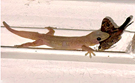
The common house gecko Hemidactylus frenatus Duméril & Bibron, 1836, preying on the Surinam cockroach Pycnoscelus surinamensis (Linnaeus, 1758), the black soldier fly Hermetia illucens (Linnaeus, 1758), the Dorantes longtail Cecropterus dorantes (Stoll, 1790), the split-banded owl-butterfly Opsiphanes fabrici (Boisduval 1870), a Leuctra satyrid butterfly Taygetis leuctra Butler, 1870, the moth Microthyris anormalis (Guenée, 1854), and the common fungus moth Metalectra discalis (Grote, 1876) is reported for the first time, through photographic records documented between December 2020 and November 2025. The observations occurred in urban areas of Chetumal city, Quintana Roo, Mexico. The prey species involved in this note are evidence of the wide variety of insects that form part of the diet of H. frenatus, particularly in the urban areas it has colonized outside its original geographic distribution.
##plugins.themes.bootstrap3.article.details##
urban environment, common house gecko, diet, prey insects, Yucatán Peninsula, Mexican Caribbean
Bell, W. J., Roth, L. M., & Nalepa, C. A. (2007). Cockroaches: ecology, behavior, and natural history. JHU Press.
Brown, T. W., Mayron, D. F., & Clayson, S. M. (2017). Hemidactylus frenatus (Asian House Gecko). Diet. Herpetological Review, 48(3), 645–646.
Cole, N. C., Jones, C. G., & Harris, S. (2005). The need for enemy-free space: the impact of an invasive gecko on island endemics. Biological Conservation, 125(4), 467–474.
https://doi.org/10.1016/j.biocon.2005.04.017
Csurhes, S., & Markula, A. (2009). Pest animal risk assessment: Asian house gecko Hemidactylus frenatus. Queensland Primary Industries and Fisheries report.
de Luna, M., Estrada-Álvarez, J. C., Núñez-Bazán, R., García-Barrios, R., Hinojosa-Díaz, I. A., & Cuéllar-Rodríguez, G. (2025). The Surinam Cockroach, Pycnoscelus surinamensis (Linnaeus, 1758) (Insecta, Blattodea, Blaberidae) in Mexico: new records with the help of citizen science. Check List, 21(2), 406–412.
Díaz-Gamboa, L., May-Herrera, D., Gallardo-Torres, A., Cedeño-Vázquez, R., González-Sánchez, V., Chiappa-Carrara, X., & Yañes-Arenas, C. (2020). Catálogo de reptiles de la península de Yucatán. Universidad Nacional Autónoma de México (UNAM).
Global Invasive Species Database. (2025). Species profile Hemidactylus frenatus. Disponible en: https://www.iucngisd.org/gisd/species.php?sc=1344 [Consultado el 30 de junio de 2025]
Huerta-de la Barrera, I. E., Escobedo-Galván, A. H., & Cupul-Magaña, F. G. (2020). Hemidactylus frenatus (Common House Gecko). Diet. Herpetological Review, 51(3), 598–599.
McCoid, M. J., & Hensley, R. A. (1993). Shifts in activity patterns in lizards. Herpetological Review, 24(1), 87–88.
Muniz-Corona, Y., Bustos-Zagal, M. G., Castro-Franco, R., & Trujillo-Jimenez, P. (2018). The Asian House Gecko Hemidactylus frenatus (Sauria: Gekkonidae), contributes to the control of hematophagous mosquitoes in urban areas of the Mexican State of Morelos. Research & Reviews: Journal of Zoological Sciences, 6(1), 17–21.
Naher, K., Alam, A. S., Rahman, S., & Kabir, M. M. (2013). Gut contents of common house gecko, Hemidactylus frenatus (Schlegel, 1836) in Jahangirnagar university campus, Savar, Bangladesh. Bangladesh Journal of Zoology, 41(2), 229–232.
https://doi.org/10.3329/bjz.v41i2.23325
Norval, G., & Mao, J. (2013). When the eyes are larger than the stomach: An instance of a Common House Gecko (Hemidactylus frenatus Schlegel, 1836) preying on a large American Cockroach (Periplaneta americana (Linnaeus, 1758)). IRCF Reptiles & Amphibians, 20(3), 140–142.
Norval, G., & Mao, J. (2014). Hemidactylus frenatus (Asian House Gecko). Prey. Herpetological Review, 45(2), 328–329.
Pellens, R., & Grandcolas, P. (2002). Are successful colonizers necessarily invasive species? The case of the so-called invading parthenogenetic cockroach, Pycnoscelus surinamensis, in the Brazilian Atlantic forest. Revue d’Écologie, 57(3–4), 253–261.
Rodriguez-Tovar, L. E., Casas-Martínez, A., Ramírez-Romero, R., Nevárez-Garza, A. M., & Zarate-Ramos, J. J. (2008). First report of Oxyspirura sp. from a captive fulvous owl (Strix fulvescens) in Mexico. Journal of Parasitology, 94(6), 1430–1431. https://doi.org/10.1645/GE-1599.1
Santoyo-De-Estéfano, F. A., Espinoza-Leija, R. R., Zárate-Ramos, J. J., & Hernández-Velasco, X. (2014). Identification of Oxyspirura mansoni (Spirurida: Thelaziidae) in a free-range hen (Gallus gallus domesticus) and its intermediate host, Surinam cockroach (Pycnoscelus surinamensis) in Monterrey, Nuevo Leon, Mexico. Acta Zoológica Mexicana, 30(1),
106–113.
Schwabe, C. W. (1949). Observations on the life history of Pycnoscelus surinamensis (Linn.), the intermediate host of the chicken eyeworm in Hawaii. Proceedings of the Hawaiian Entomological Society, 13(3), 433–436.

This work is licensed under a Creative Commons Attribution-NonCommercial 4.0 International License.
How to Cite
Article metrics
- 327 Views Summary views
- 157 Downloads PDF Downloads
- 67 Views Html Views